Guardrails for the Future: Sensitivity Labels and Access Controls in Fabric

In a world where data moves faster than governance, the question isn’t just how to access information—but how to trust it.

As organizations accelerate their adoption of Microsoft Fabric, data is no longer confined to silos. It flows freely across workspaces, reports, and pipelines. That freedom is powerful—but without governance, it can quickly become exposure.

That’s why sensitivity labels and access controls aren’t optional features. They’re the guardrails that keep innovation on track and ensure your data highway remains safe, compliant, and trusted.

The Unified Data Challenge

Microsoft Fabric unifies analytics across services—Data Factory, Synapse, Power BI, and more—into a single connected environment. While this unlocks agility, it also raises the stakes.

When every report, dataset, and notebook can tap into shared resources, one missing label or overly broad permission can expose sensitive information far beyond its intended scope.

Through its deep integration with Microsoft Purview, Fabric brings compliance, classification, and control into one seamless governance experience—right where data lives and moves.

Sensitivity Labels: Classification That Travels with Your Data

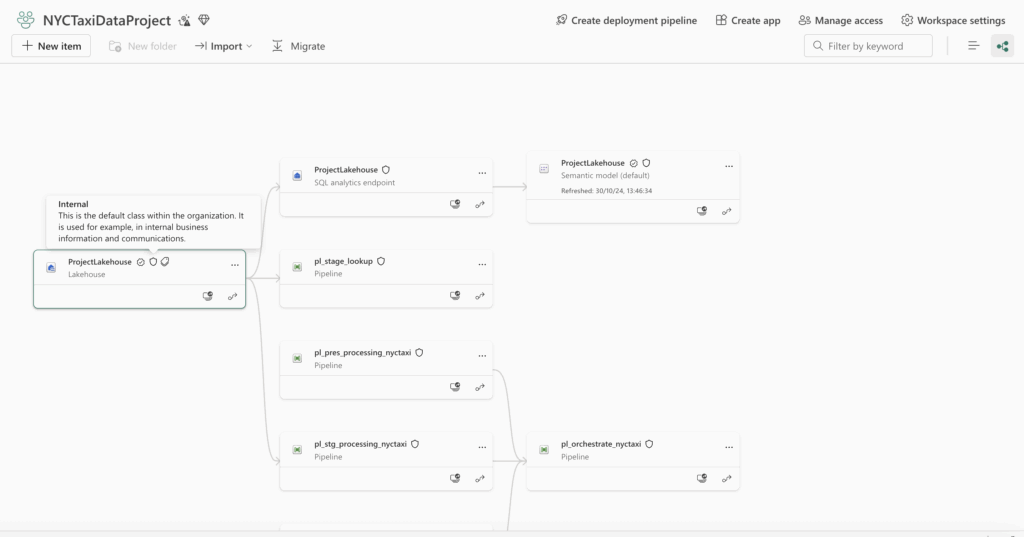
Think of sensitivity labels as digital seatbelts. Once applied, they travel wherever your data goes, ensuring protection remains intact across storage, movement, and visualization.

Sensitivity Labels: Classification that travels with Your Data” can’t be used.

For example, a “Highly Confidential” label can:

  • Automatically encrypt files
  • Restrict sharing and export
  • Apply usage rights across services

Because Fabric integrates deeply with Microsoft Purview, these policies stay consistent—whether the data lives in OneLake, Power BI, or downstream analytics.

This consistency closes one of the biggest gaps in modern governance: policy fragmentation. And beyond compliance, it builds a culture of accountability, where every analyst and developer becomes a steward of data protection.

Access Controls: Precision Permissions from Tenant to Item Level

If sensitivity labels are the seatbelts, access controls are the steering system—they determine who can go where, and under what conditions.

In Microsoft Fabric, governance happens at multiple layers, allowing you to apply precise permissions from the top down:

  1. Tenant Level – Global governance boundaries are established here. Admins manage overarching policies, user directories, and Azure AD integration. This defines the outer perimeter of access and ensures compliance across the entire Fabric environment.
  2. Domain Level – Domains represent functional groupings (like Finance, HR, or Engineering). Access policies at this level align governance with business structures, allowing each domain to manage its data autonomously within unified oversight.
  3. Workspace Level – The workspace is the collaboration hub. Access controls here determine who can view, contribute, or administer Fabric content such as pipelines, datasets, notebooks, or reports.
  4. Item (Object) Level – This is where governance becomes surgical. Permissions can be defined directly for Fabric items such as:
    • Lakehouses / Warehouses: Control who can read, modify, or query specific tables and schemas.
    • Pipelines: Manage who can author, execute, or monitor dataflows.
    • Reports / Dashboards: Restrict viewing, sharing, or exporting of visuals containing sensitive data.
    • Notebooks / Semantic Models: Limit who can interact with or publish analysis results.

Because these layers are powered by Azure AD roles and Purview policies, permissions scale effortlessly. Administrators can enforce the principle of least privilege consistently—from the tenant’s global boundary to an individual dataset—without duplication or manual overhead.

Result: Data democratization with precision—empowering collaboration while maintaining accountability and compliance at every level.

How It Works in Practice

Consider a financial services team using Fabric to unify data from multiple subsidiaries. By applying sensitivity labels and attribute-based access rules, they ensure that:

  • Customer identity data is encrypted end-to-end.
  • Analysts only access records within their regional scope.
  • Reports automatically inherit protection labels from their datasets.

The result? Security isn’t a manual step—it’s baked into the workflow, saving hours of policy enforcement and audit preparation every month.

Balancing Freedom and Control

True governance isn’t about restriction—it’s about enabling safe innovation. Sensitivity labels and access controls create that balance:

  • Freedom with boundaries
  • Creativity with confidence

By embedding these guardrails early in your Fabric deployment, you don’t just respond to compliance needs—you anticipate them. You future-proof your organization’s ability to manage risk, maintain compliance, and uphold trust as your data estate grows.

The Road Ahead

The future of analytics will belong to organizations that govern boldly and govern early. Sensitivity labels and access controls aren’t just security settings—they’re the ethical and strategic frameworks that define responsible innovation.

Guardrails don’t slow progress—they make it sustainable.

When integrated from the start, Fabric’s governance tools don’t just protect data—they preserve your organization’s credibility, compliance posture, and future agility.

middle belt blog

Related Post